The Forward Deployed Engineer and the Reinvention of Microsoft Consulting
Why the billable-hour shop is giving way to small, embedded agent-deployment teams, and what a Microsoft partner should do about it in FY27

In one paragraph: AI projects keep stalling between pilot and production. The industry's answer is the Forward Deployed Engineer (FDE), an engineer who embeds with the customer, ships production code against real data, and owns the business outcome. In 2026 every major AI vendor built an FDE arm, and Microsoft launched its own: the Microsoft Frontier Company, a $2.5B, 6,000-person unit. At the same time Microsoft rewired partner incentives to pay for adoption and consumption growth instead of license resale. For a small or mid-sized Microsoft partner, the winning move is to become a small, senior, embedded "agent deployment" firm that sells fixed-fee and outcome-linked packages, rather than a time-and-materials staffing shop competing with Microsoft's own engineers.
Table of contents
- What a Forward Deployed Engineer actually is
- Why the FDE model exploded in 2025–2026
- The software development shift underneath it
- How consulting itself is being rebuilt
- The Microsoft partner ecosystem in FY27
- A playbook for small and mid-sized Microsoft partners
- Risks, hype and what to verify
- Sources
1. What a Forward Deployed Engineer actually is
A Forward Deployed Engineer is a software engineer who works inside the customer's organization to make a vendor's product run in production, on the customer's real data and systems. Three things set the role apart:
- The FDE writes production code, not just demos.
- The FDE owns a business outcome, not a statement of work.
- What the FDE learns flows back into the product or into reusable IP.
The Palantir origin: Delta and Echo
Palantir popularized the model for customers whose requirements could not be written down in advance. It works as a pair:
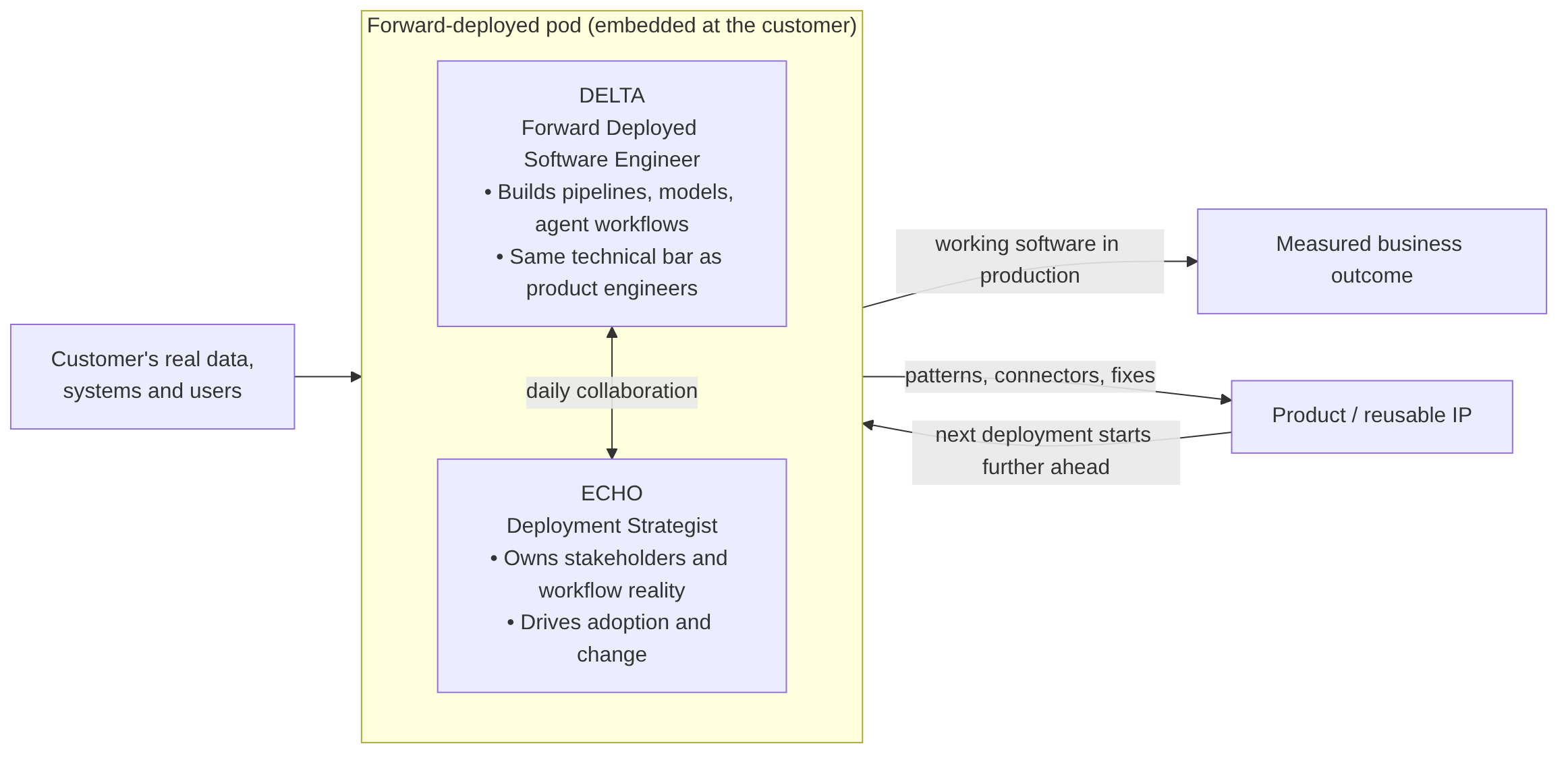
Former Palantir executive Bob McGrew calls this "doing things that don't scale — at scale." The two halves need each other. A Delta alone builds something technically correct but irrelevant to how people work. An Echo alone produces strategy with nothing shipped.
The loop at the bottom of the diagram matters most. Palantir made the model profitable by turning each deployment into product. For a consultancy, the equivalent is reusable IP: connectors, evaluation suites, governance templates and agent patterns.
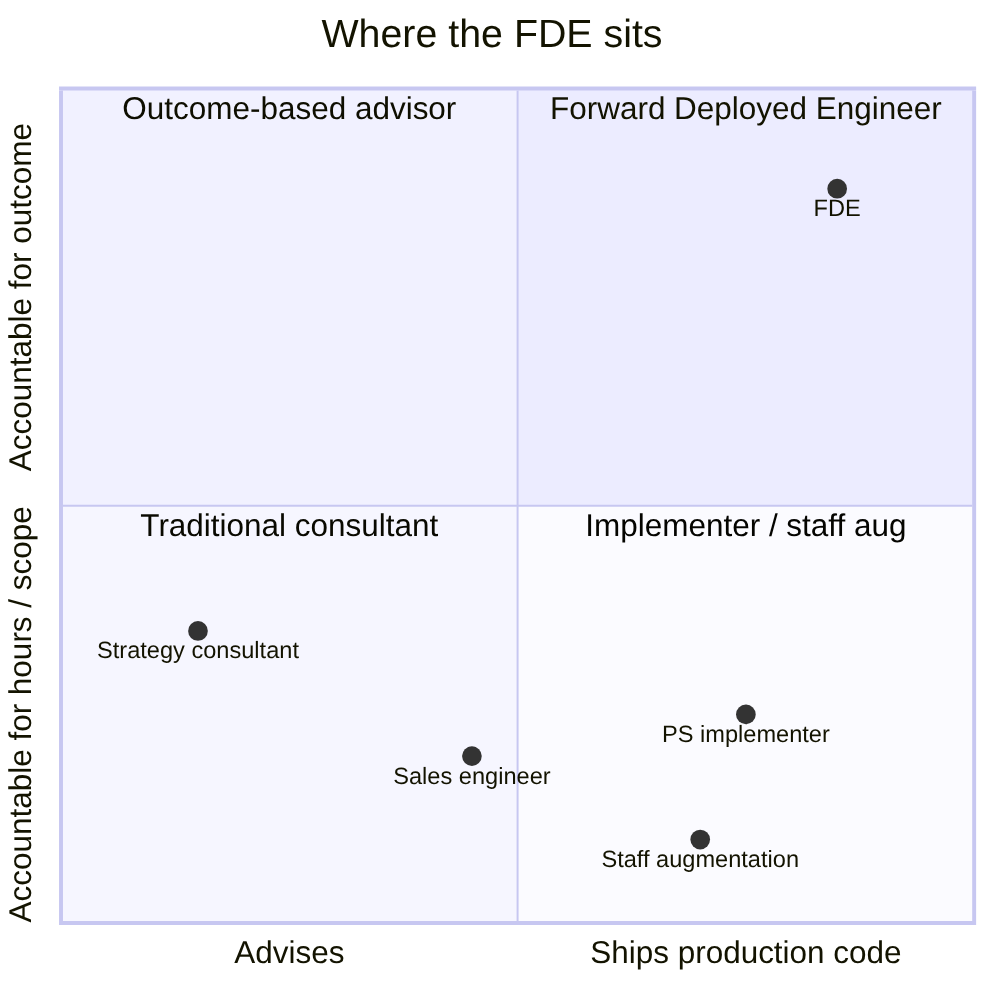
How the FDE differs from roles you already have
| Role | Primary goal | Writes production code? | Engagement | Measured on |
|---|---|---|---|---|
| Forward Deployed Engineer | Make it work in production for this customer; feed the product | Yes, extensively | Months, embedded | Customer outcome, product learnings |
| Sales / solutions engineer | Win the deal | Demo / PoC code | Weeks, pre-sale | Bookings |
| Traditional consultant | Advise, design, manage change | Rarely | Project-based | Billable hours, utilization |
| Professional services implementer | Configure to a spec | Yes, to spec | Fixed scope | Hours, on-time delivery |
The real difference is accountability. An FDE challenges the requirements rather than executing them. Avanade's own FDE job ads make the point bluntly: this is not an order-taking role.
2. Why the FDE model exploded in 2025–2026
The last-mile problem of agentic AI
AI agents rarely fail because of the model. They fail in the last mile:
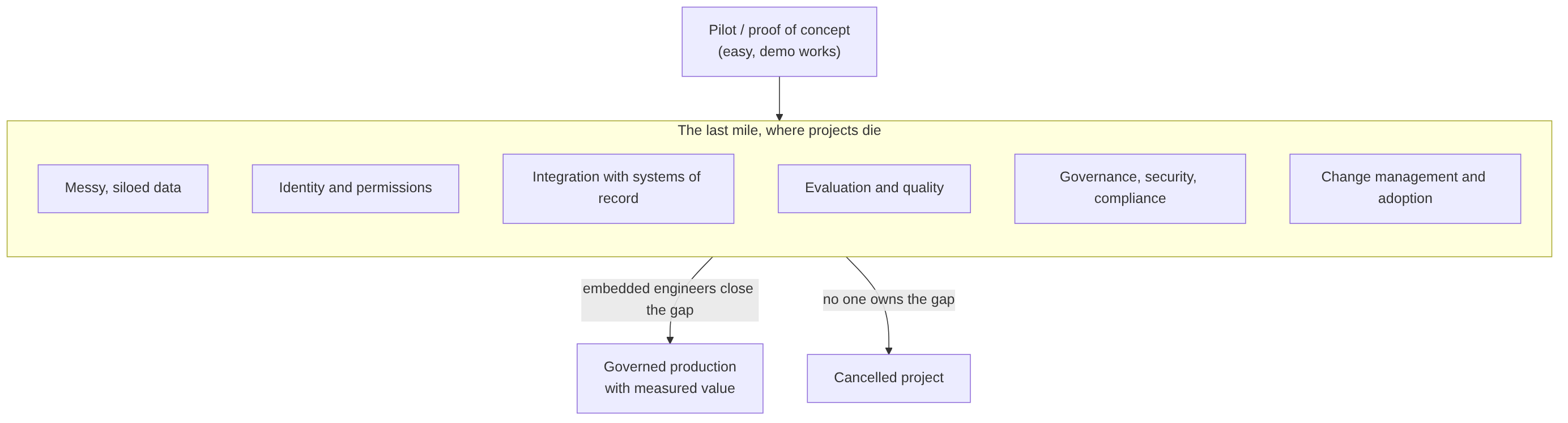
Gartner predicts that more than 40% of agentic AI projects will be canceled by the end of 2027 because of escalating costs, unclear business value or weak risk controls. It also estimates that only about 130 of the thousands of vendors claiming agentic capabilities are real, and calls the rest "agent washing."
That failure rate is the opportunity. Someone has to sit inside the customer and close the gap.
Vendors move down into services
The second driver is economics. AI vendors earn money on consumption, and consumption only arrives once deployments succeed. So vendors are now subsidizing implementation:

Directions on Microsoft summed it up: free deployment is the customer acquisition cost, and the consumption meters are the payback.
Who built FDE arms
| Company | FDE commitment |
|---|---|
| Microsoft | Microsoft Frontier Company: $2.5B, ~6,000 engineers, consultants and sellers (July 2, 2026) |
| AWS | $1B forward-deployed engineering initiative (June 30, 2026) |
| OpenAI | Deployment business backed by more than $4B |
| Anthropic | $100M to train 10,000 FDEs by end of 2027 via a residency; early cohorts include engineers from Accenture, Bain, Capgemini, Deloitte and McKinsey |
| Google Cloud | Hundreds of FDE hires planned; 1,000-person FDE workforce with Accenture |
| Salesforce | 1,000 FDEs for Agentforce; tripled its FDE team in six months |
| Others | Databricks, Cohere, Mistral, Glean, Ramp, Rippling and many AI startups |
The demand numbers, with a health warning
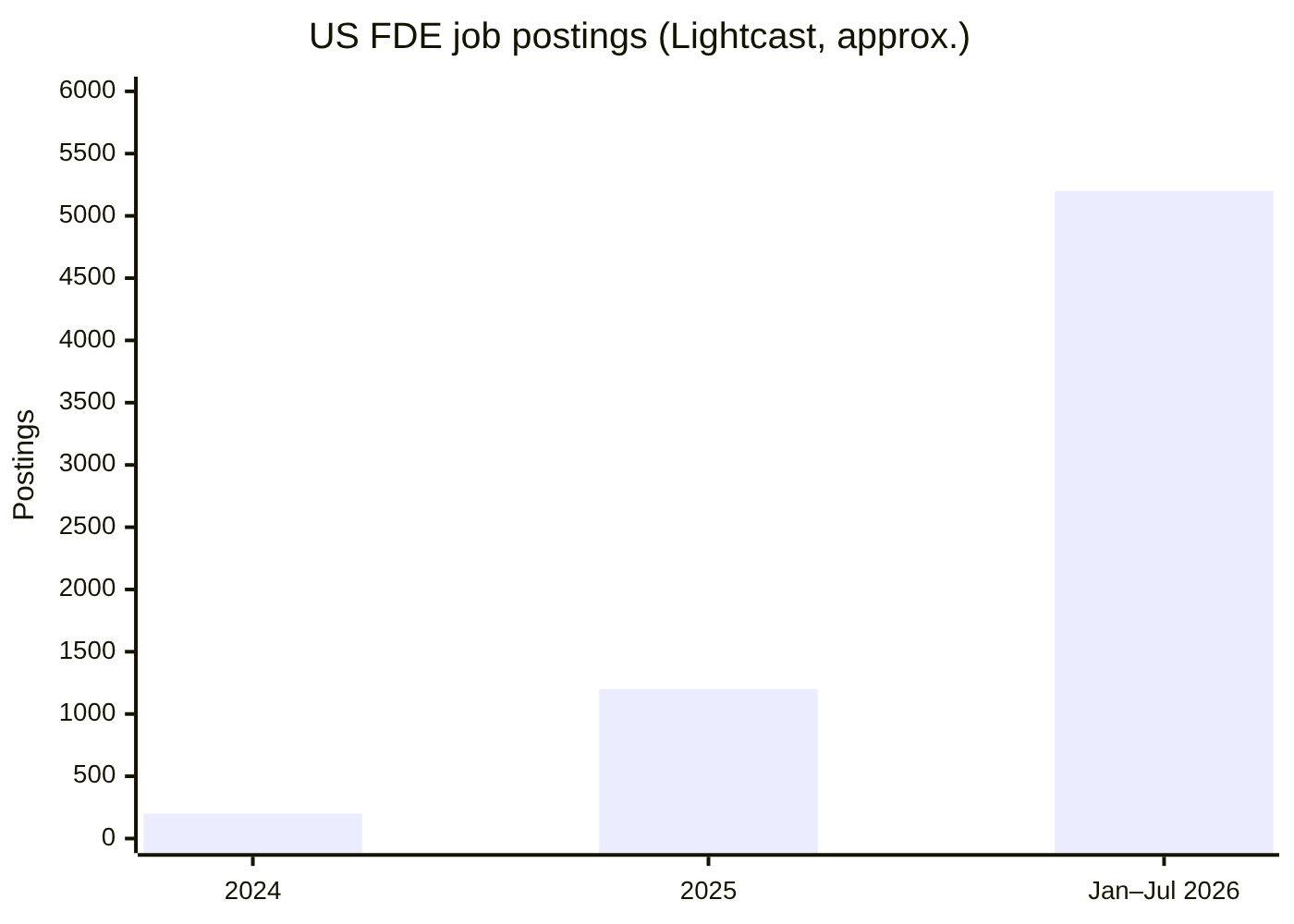
Every tracker shows growth in the hundreds of percent:
| Source | Metric | Figure |
|---|---|---|
| Indeed / Financial Times | Postings growth, Jan–Sep 2025 | >800% |
| Bloomberry (Revealera data) | Jan–Oct 2025 vs. Jan–Oct 2024 | +1,165% |
| Indeed via Business Insider | Year over year to April 2026 | ~729% |
| Lightcast (US) | Annual postings | ~200 → ~1,200 → 5,200+ |
Two cautions. The base is small, so FDE remains a niche title. And these figures count postings, not hires. Recruiting platforms and bootcamps, which benefit from the hype, amplify many of them.
What FDEs earn and what they need to know
- Median base pay across ~1,000 postings: about $174K (Bloomberry). Levels.fyi puts the overall median near $220K.
- Top of the market: Anthropic staff FDE $280K–$320K base; OpenAI New York $220K–$280K plus equity.
- Microsoft ecosystem: Avanade Sydney FDE A$160K–A$210K.
- Nearshore: senior FDEs in Latin America at about $80K–$120K.
Required skills cluster around strong software engineering (Python appears in about two-thirds of postings), LLM integration, retrieval (RAG), agent workflows and tool use, evaluations, cloud and data engineering, and the credibility to work directly with customer executives.
For a Microsoft boutique, the implication is clear. Real FDE talent costs well above a typical consulting rate card, and you are competing with AI labs and hyperscalers to hire it.
3. The software development shift underneath it
The FDE trend sits on top of a bigger change in how software gets built.
From writing code to directing agents
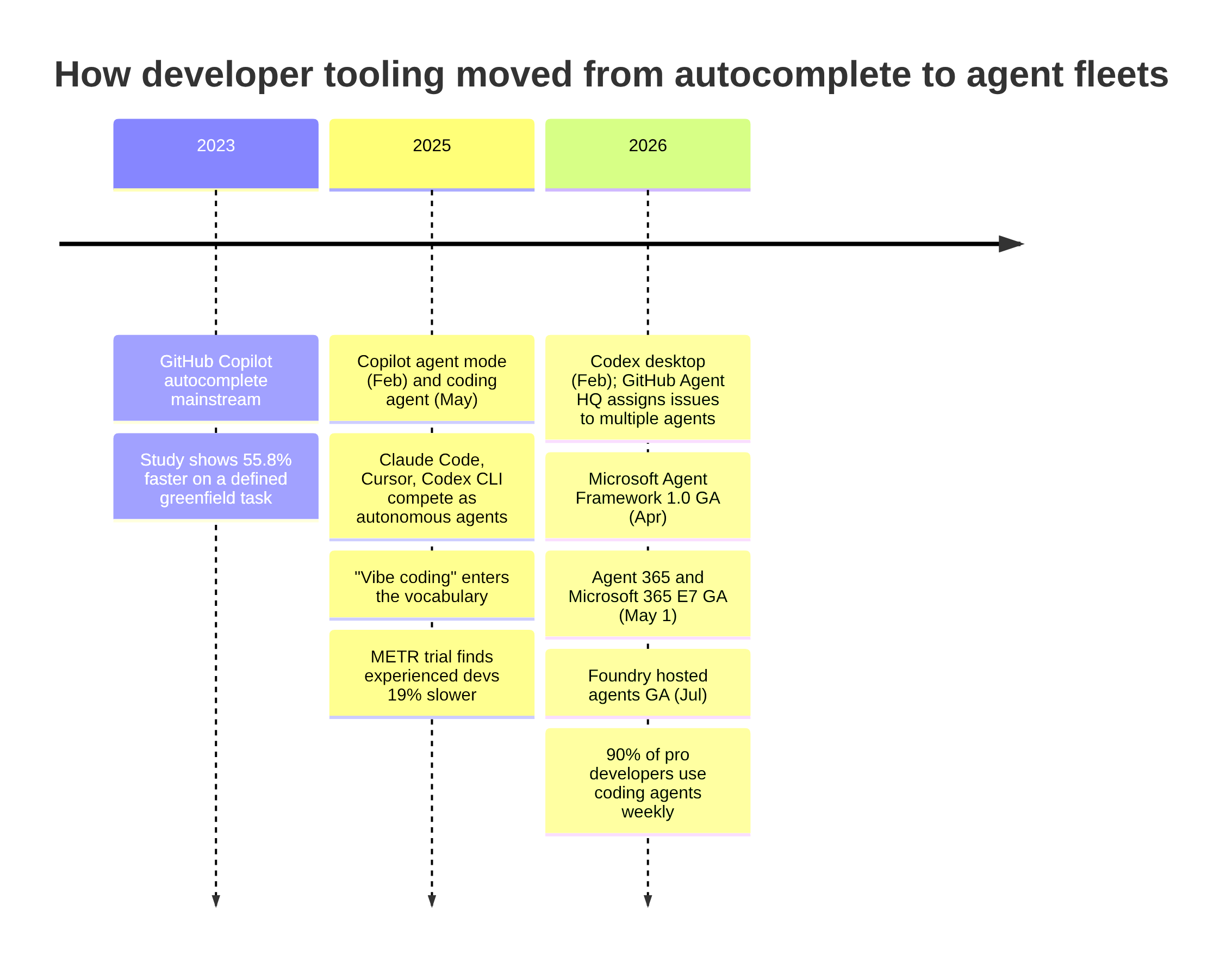
According to JetBrains (May–July 2026), 90% of professional developers use AI coding agents at least weekly and 68% daily. Workplace adoption by tool:
| Tool | Workplace adoption, mid-2026 |
|---|---|
| Claude Code | ~39% (up from 18% in January 2026) |
| GitHub Copilot | 21% |
| OpenAI Codex | 16% |
| Cursor | 12% |
The picture shifts by company size. The Pragmatic Engineer 2026 survey finds GitHub Copilot leads at 56% in enterprises with 10,000+ employees. For Microsoft-centric clients, Copilot is still the default purchase, but developers increasingly use several agents.
Microsoft's agent stack, in one picture
Microsoft's product line now mirrors the move from custom software to configured and orchestrated agents:
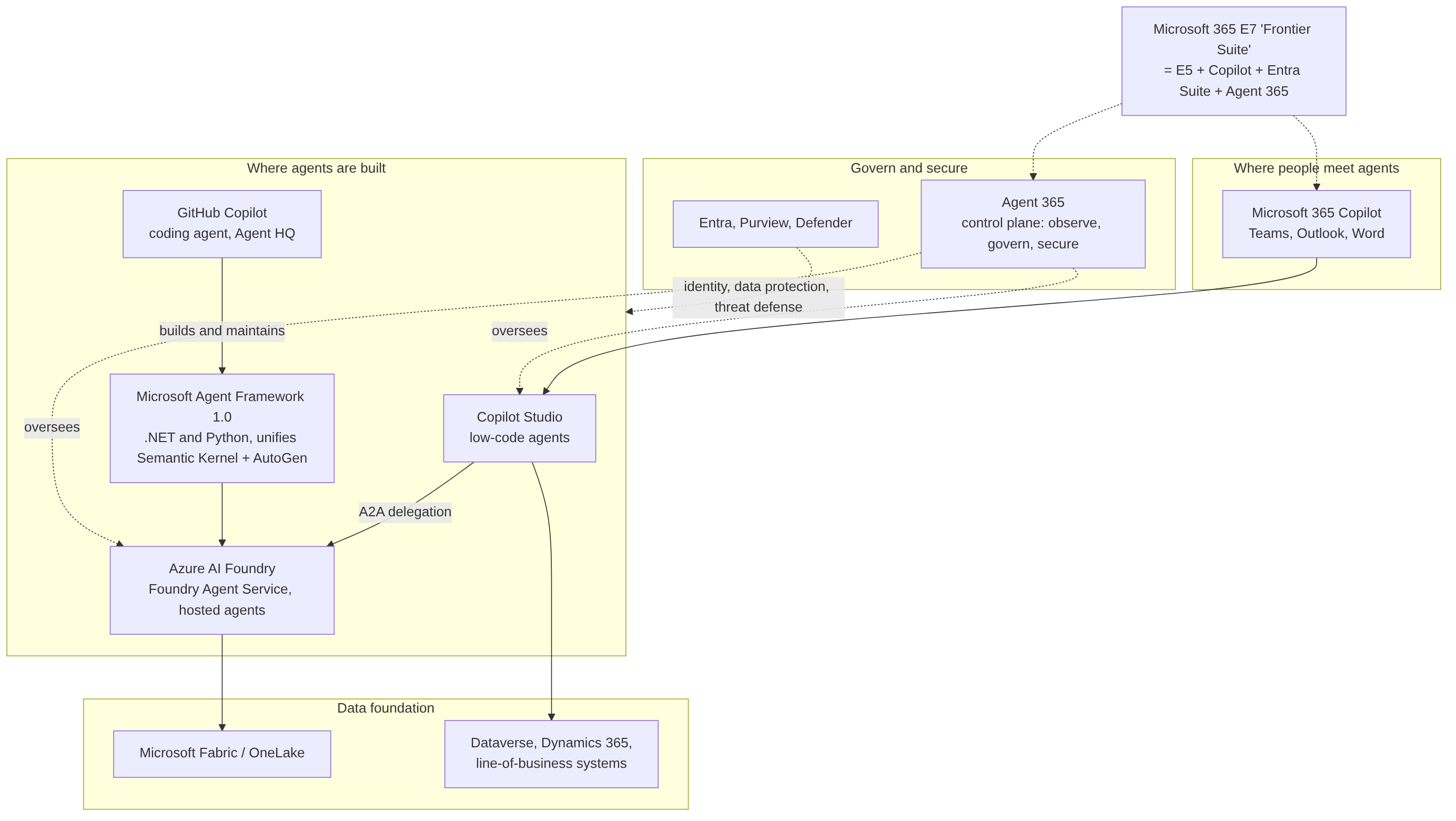
Key facts:
- Microsoft Agent Framework 1.0 reached general availability in April 2026, unifying Semantic Kernel and AutoGen. Connectors for the GitHub Copilot SDK and Claude Agent SDK followed around Build 2026.
- Foundry hosted agents reached GA in July 2026. They provide a managed, consumption-billed runtime that accepts any framework (Agent Framework, LangGraph, OpenAI Agents SDK).
- Agent 365 ($15 per user per month standalone) and Microsoft 365 E7 became generally available on May 1, 2026.
- Copilot Studio can delegate agent-to-agent (A2A) to Foundry orchestrations, so a low-code front end can call a pro-code back end.
Where the value moves
When prototyping becomes nearly free, the scarce skills move:

The productivity evidence is real but messy
| Study | Setting | Finding |
|---|---|---|
| GitHub / Microsoft Research (2023) | Defined greenfield task | 55.8% faster with Copilot |
| METR RCT (July 2025) | 16 experienced open-source devs, 246 tasks in their own mature repos | 19% slower with AI, while believing they were ~20% faster |
| METR follow-up (Feb 2026) | 57 devs, 800+ tasks | No reliable estimate; developers refused to work without AI. METR believes tools likely sped people up by early 2026 |
AI helps most with greenfield work, boilerplate and unfamiliar code, and least with expert work in deep-context systems. Review, integration and rework absorb part of the gain.
Pricing warning for consultancies: METR found a gap between how fast developers felt and how fast they were. If your team believes it is 30% faster and is not, fixed-fee bids built on that belief will lose money. Measure your own uplift before you price on it.
Smaller, more senior teams
The new delivery shape is a small senior team directing many agents:
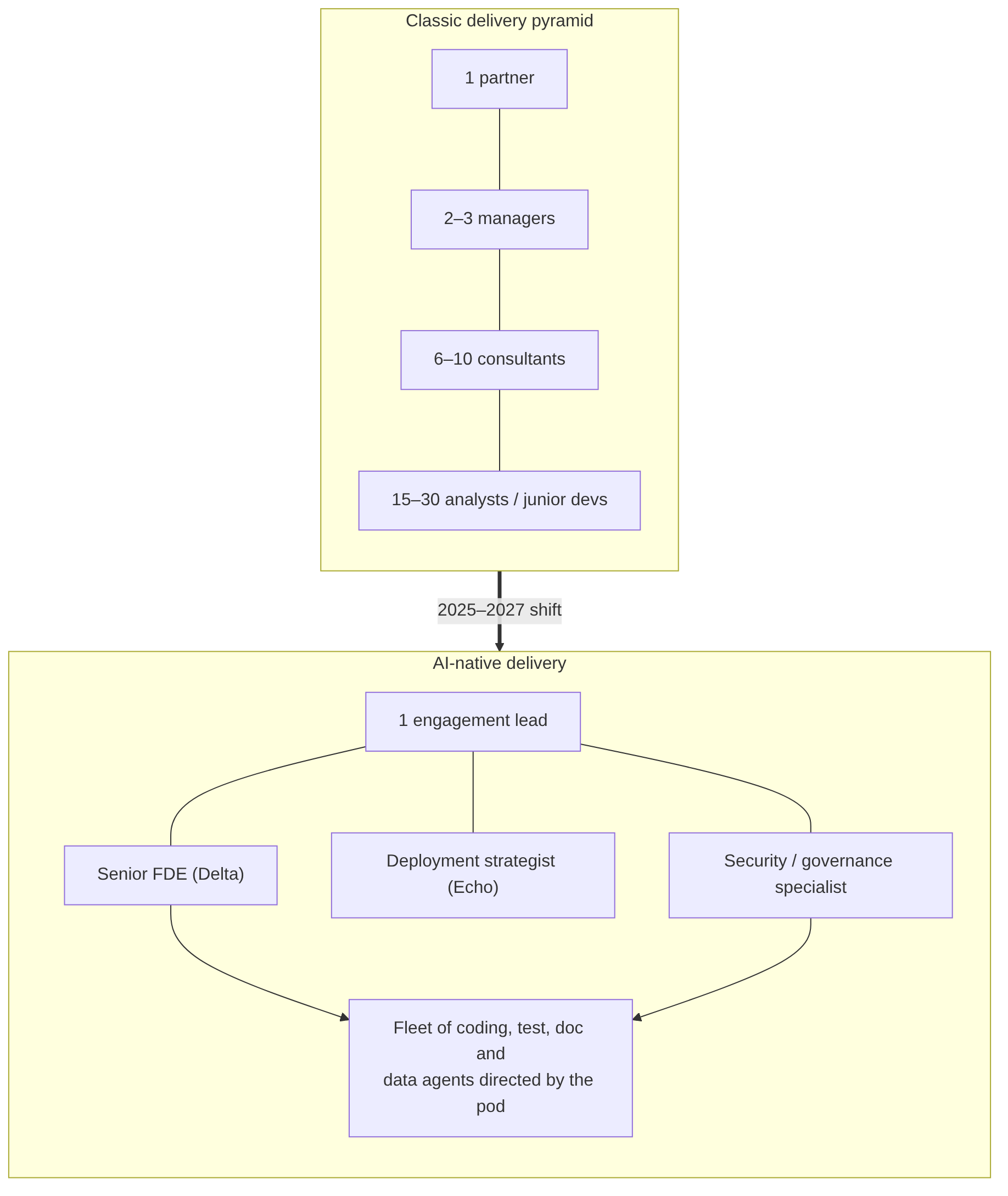
- Avanade describes its model as small expert teams directing agent networks rather than large delivery pyramids.
- KPMG's global AI workforce lead says the firm wants juniors to become managers of agents.
- Accenture's revenue per person rose in FY26, but its headcount still grew about 5%. So far AI is changing the mix of roles more than shrinking total demand.
4. How consulting itself is being rebuilt
From billable hours to outcomes

The evidence is strong at the top of the market:
- McKinsey: UK managing partner Michael Birshan said in November 2025 that the firm is doing more performance-based arrangements with clients. Business Insider put outcome-based work at about a quarter of fees; a June 2026 WSJ report put it above 30%. The figures reflect different dates and definitions, but the direction is clear.
- Deloitte: at an internal webcast reported by the WSJ, a US public sector leader projected that labor-based hourly consulting will shrink as a share of the market by 2035. One consultant summarized the message as: "They heavily implied our model is toast." Deloitte's June 2026 accounting guidance describes four outcome-pricing structures and warns about revenue-recognition risk.
- HFS Research calls the shift "Services-as-Software", a $1.5 trillion opportunity in which delivery moves from labor to platforms, IP and agents. HFS finds the bottleneck is now operating models, data readiness and governance, not technology.
Buyers have not settled on one model. HFS's November 2026 buyer survey:
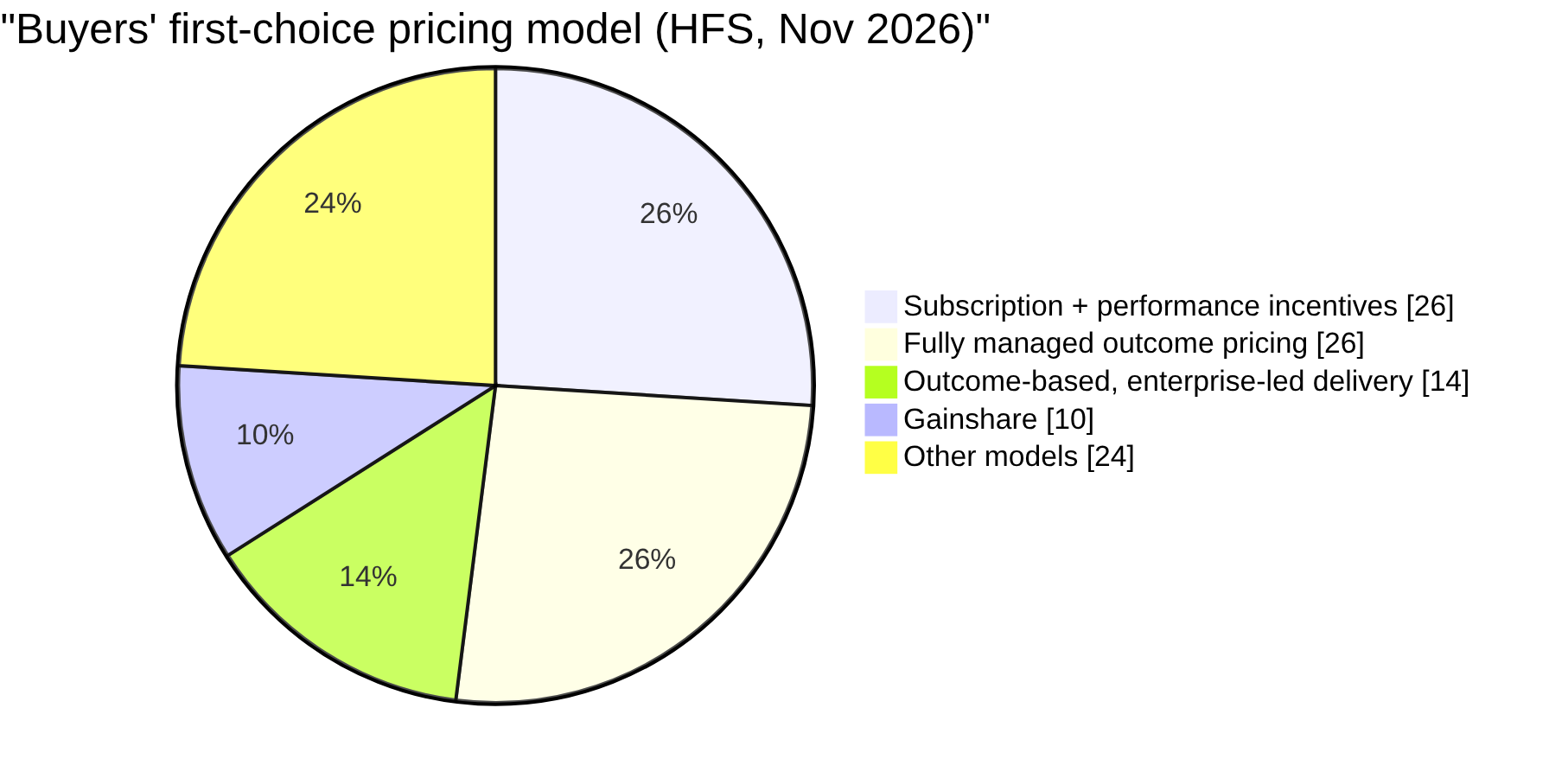
Reality check: as of early 2026, commentators still described the shift to outcome pricing as sluggish, with hybrid models dominant. No one has standardized how to value an "outcome."
The pyramid is narrowing at the base
| Firm / region | Change |
|---|---|
| KPMG UK | Graduate cohort cut from 1,399 (2023) to 942, about −33% |
| Deloitte / EY / PwC UK | Graduate intakes −18% / −11% / −6% |
| PwC US | Plan to cut graduate hiring by a third over three years; global headcount still rose to ~370,000 |
| KPMG US | |
| McKinsey and BCG | Starting salaries frozen for a third straight year |
| TCS |
The pyramid is not disappearing. It is narrowing at the base and shifting toward offshore hubs, technologists and AI specialists.
What the big firms are doing
| Firm | AI moves |
|---|---|
| Accenture | ~110,000 AI and data professionals at FY26 end; 400+ clients started advanced AI work in FY26; dedicated Microsoft FDE practice (March 2026); 1,000-person FDE workforce with Google Cloud |
| Avanade | Hiring FDEs for "Avanade Next" on its Agentic Platform plus Copilot Studio and Azure AI Foundry; re-skilling delivery engineers into FDEs; every engagement must contribute reusable IP |
| EY | $1B, five-year FDE initiative with Microsoft (May 2026); experimenting with outcome billing |
| KPMG, PwC, Capgemini | Named Microsoft Global SI FDE partners; mass AI upskilling |
| IBM Consulting | "Imagine Enterprise" with Microsoft (Nov 2026): joint FDEs plus 6,000+ pre-built agents and assets |
| Deloitte, McKinsey, Bain, Capgemini | Engineers enrolled in Anthropic's FDE residency |
The common thread is IP that compounds. HFS's strongest 2026 case submissions share a pattern: a measured baseline before deployment, outcomes tracked for months, and pricing tied to results.
5. The Microsoft partner ecosystem in FY27
This is where the trend becomes very concrete for Microsoft partners. FY27 runs from July 2026 to June 2027.
Microsoft now competes in FDE directly
On July 2, 2026, Judson Althoff, CEO of Microsoft Commercial Business, announced the Microsoft Frontier Company:
- A $2.5B unit of about 6,000 engineers, consultants and sellers that designs, deploys and runs AI systems for customers. Its tagline is "No Pilots. Scale from Day One."
- It appears to be a makeover of Industry Solutions Engineering (formerly Microsoft Consulting Services) and the Cloud Solution Architect program, not a separate company. It is unclear how much of the $2.5B is new money.
- Microsoft names Accenture, Capgemini, EY, KPMG and PwC as its Global SI FDE partners and says it will extend the approach across all markets and segments.
Analyst Lane Shelton of Directions on Microsoft warned that an embedded Frontier engineer effectively installs Microsoft's roadmap as the customer's architecture. Mary Jo Foley noted that other partners could be disintermediated.
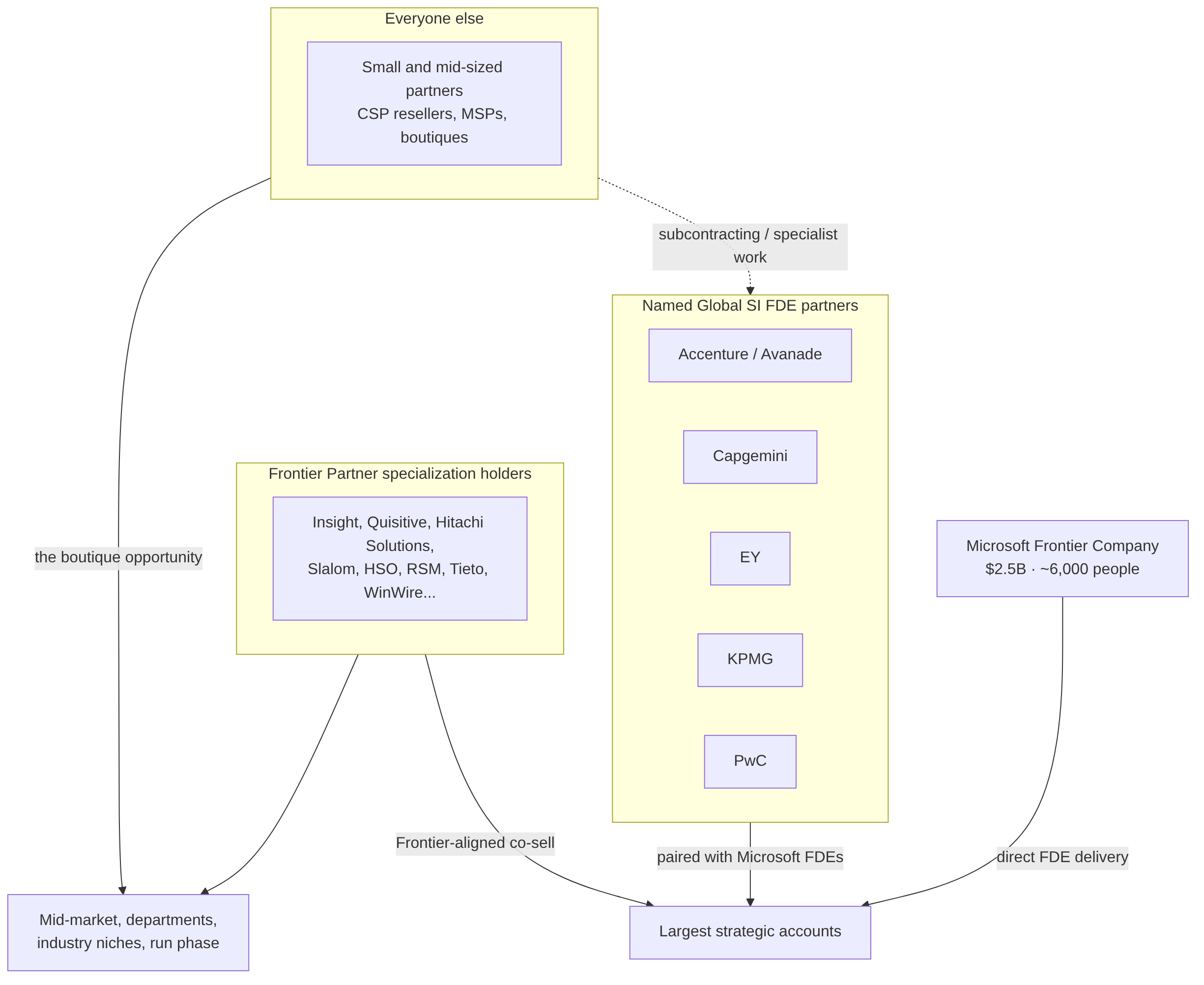
There is a partner-facing counterpart: the Frontier Engineer badge, which uses the same profile and skilling method as Microsoft's own FDEs. It trains partner architects to build production agents across Copilot, Copilot Studio, Azure AI Foundry, GitHub Copilot, Fabric and Agent 365.
Microsoft's stated view of partners
Chief Partner Officer Nicole Dezen wrote in April 2026 that partners are a meaningful differentiator, and urged a shift from transaction-first to outcome-first. She highlighted three areas: agentic workflows, "Customer Zero" maturity (partners using Copilot and agents internally), and security as the foundation.
The new qualification ladder
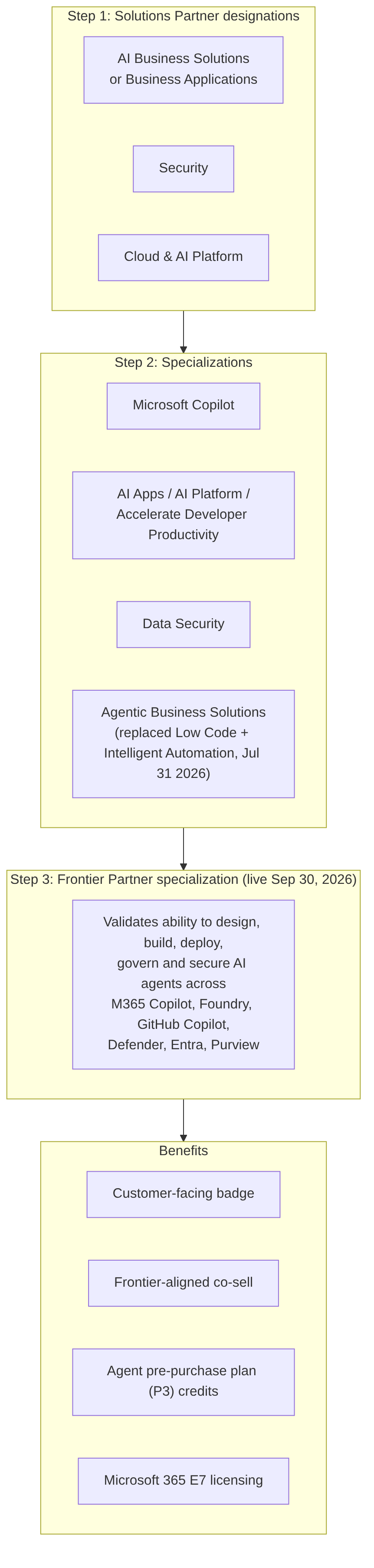
Plan on six to nine months. Tieto reported that earning the badge took about eight months; Quisitive earned it in May 2026 after its 19th specialization. Microsoft has also announced an Agentic Partner Capability Score for FY27, though it has not published how the score works.
Follow the money: incentives now reward usage, not seats
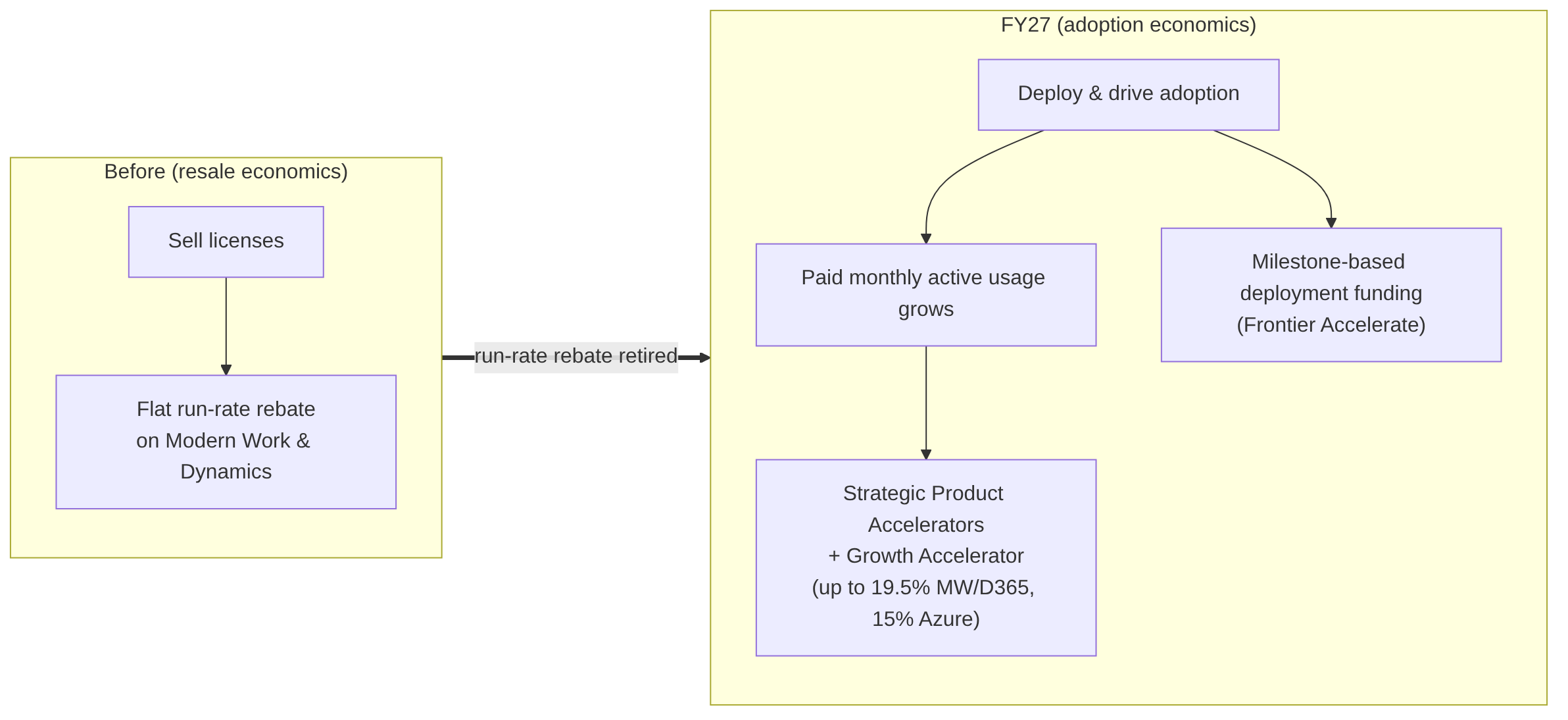
The FY27 changes that matter most:
- Frontier Accelerate consolidates incentives, funding, skilling and co-sell into one framework. Microsoft says it is increasing margin on strategic AI workloads, including Microsoft 365 Copilot, E5 and E7, and guides partners to put 30% of co-op investment toward Copilot.
- The flat run-rate rebate on Modern Work and Dynamics 365 is retired.
- Copilot incentives depend on growth in paid monthly active usage.
- Moving a customer from another partner earns the new partner only growth incentives.
- From October 2026, margins drop 5% on several legacy SKUs, including Office 365 E1/E3 and Microsoft 365 Apps.
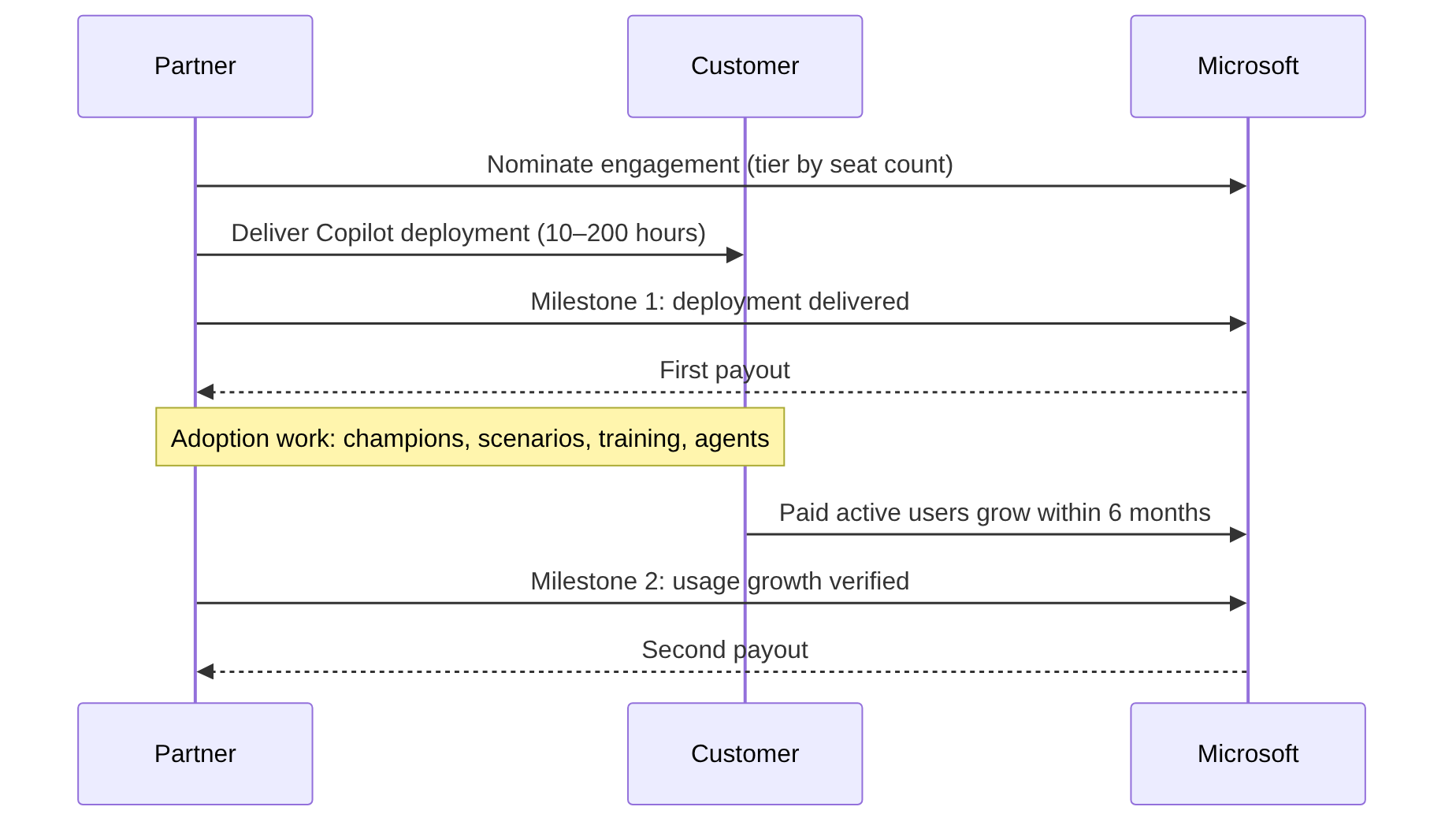
Copilot Deployment Accelerator (from October 1, 2026, Market A rates)
The accelerator pays in two milestones: one when the deployment is delivered, and one when paid active users grow within six months.
| Tier | Seats | Hours | Total payout |
|---|---|---|---|
| XXS | 50+ | 10 | $2.5K |
| XS | 300+ | 20 | $5K |
| S | 500+ | 40 | $10K |
| M | 1,500+ | 100 | $25K |
| L | 3,000+ | 200 | $50K |
Other funding levers
- Agent Solution Deployment Accelerator: post-sale funding for partner-led agent and Power Platform solutions. Amounts are not published.
- Envisioning and PoC funding: up to $25K per engagement, according to partner summaries. Microsoft has not confirmed the eligibility rules in a primary source.
- Cloud Accelerate Factory: free Microsoft-delivered deployment help across 30+ Azure services. Since July 2026 it is open to partners with eligible specializations and can be combined with partner incentives.
- SMB: from August 1, 2026, CSP partners can offer a 30-day Microsoft 365 Copilot trial for up to 25 users that converts automatically to paid.
- ECIF: no FY27 primary-source terms were found. It appears to continue as a discretionary channel that Microsoft's field nominates deals into.
Customers pay more; resellers earn less
Microsoft 365 list prices rose on July 1, 2026:
| SKU (per user/month) | Before | From July 1, 2026 |
|---|---|---|
| Microsoft 365 E3 | $36 | $39 |
| Microsoft 365 E5 | $57 | $60 |
| Office 365 E3 | $23 | $26 |
| Microsoft 365 F3 | $8 | $10 |
| Business Standard | $12.50 | $14 |
| Business Premium | $22 | $22 (unchanged) |
On November 1, 2025, Enterprise Agreement volume discount levels were already replaced by a single price level.
The upshot: license resale is becoming a thin-margin utility. Microsoft is pushing partner economics toward adoption, consumption growth and services.
How partners are repositioning
| Partner | Repositioning |
|---|---|
| Avanade | FDE track inside "Avanade Next" across APAC, UK and India |
| Insight | Launch partner for E7 and Agent 365; reports 91% internal Copilot adoption and 7,400+ agents built as "Client Zero" |
| Quisitive | Frontier Partner (May 2026); Airo AI accelerator for launching and governing agents; AI Security Quick Start |
| Hitachi Solutions | Agent 365 launch partner with a governance-first model; claims agents in operation in under a month |
| atQor (India) | 252 agents built in FY26; 25 productized on Microsoft Marketplace |
| Invoke (US) | 2026 Secure AI Productivity Partner of the Year; runs security and AI as parallel workstreams |
The pattern is consistent: Customer Zero credibility, governance and security as the way in, packaged offers on Marketplace, and reusable agent IP. Keep in mind that agent counts, adoption rates and savings in these announcements are self-reported.
6. A playbook for small and mid-sized Microsoft partners
Pick the right battlefield
Do not try to out-scale Microsoft Frontier Company or the global SIs on large enterprise FDE programs. Frontier will concentrate on the biggest strategic accounts, and Microsoft needs partners for breadth. A boutique can win in:
- the mid-market and departmental enterprise work;
- industry and process niches;
- running agents after deployment.
A clear positioning line: "The embedded agent team that takes Microsoft AI from pilot to governed production in weeks, then runs it."
Build an FDE pod
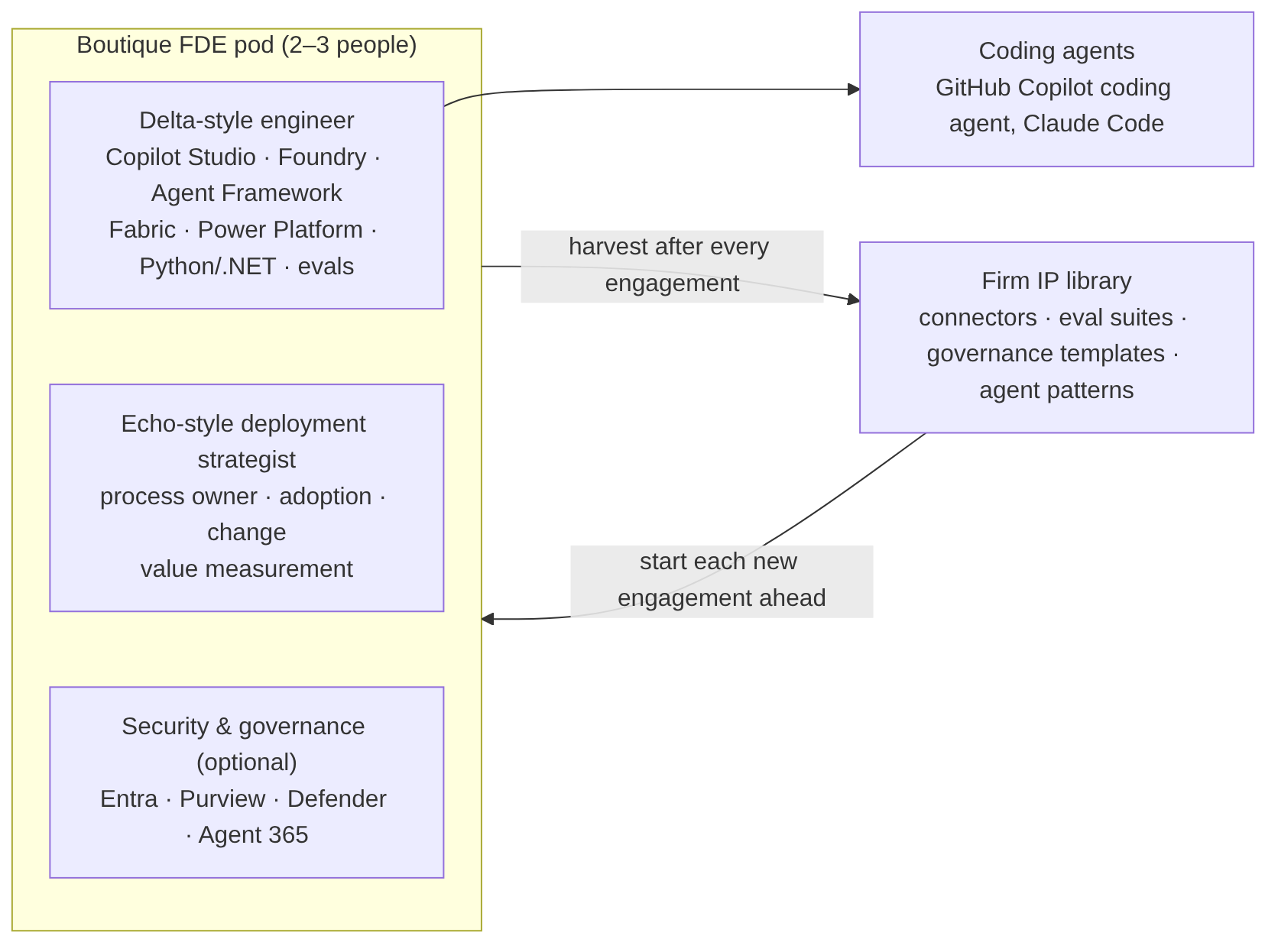
Five operating rules:
- Embed with real access. Work in the client's tenant, repos and stand-ups. Ship a working agent in the first two to three weeks.
- Own a metric. Start every engagement with a measured baseline: hours, cycle time, resolution rate. Microsoft's milestone funding and any outcome pricing both depend on it.
- Harvest IP every time. This is what separates FDE from expensive staff augmentation.
- Use coding agents internally, and measure the real uplift before pricing on it.
- Be Customer Zero. Run your own firm on Copilot and agents. Microsoft rewards it, and it produces case studies.
The engagement lifecycle
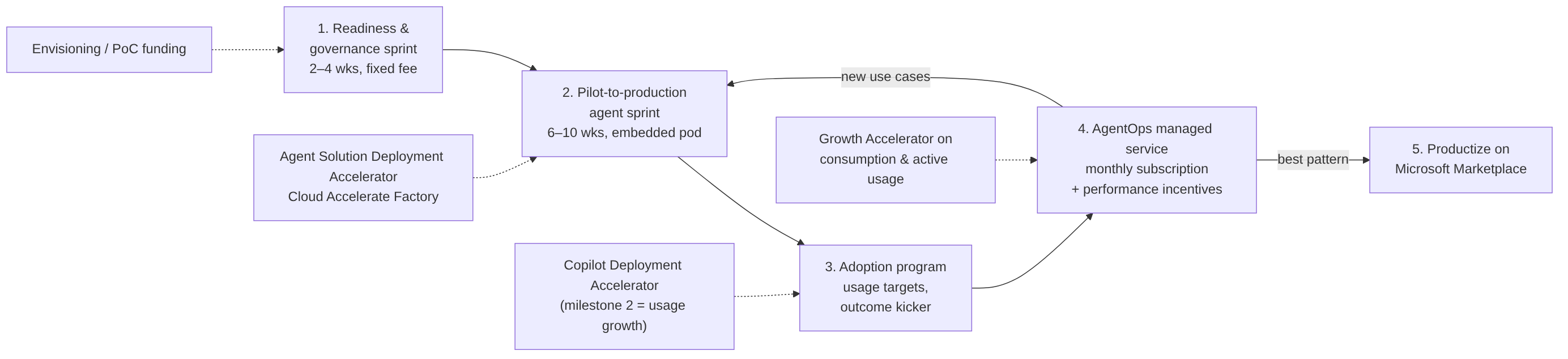
Service catalog
| Offering | Format | Microsoft funding lever |
|---|---|---|
| AI readiness and governance sprint (data, identity, Purview / Agent 365 controls) | 2–4 week fixed fee | Envisioning / PoC; security incentives |
| Copilot deployment and adoption program | Fixed fee per seat tier + adoption kicker | Copilot Deployment Accelerator ($2.5K–$50K) |
| Agent "pilot-to-production" sprint (Copilot Studio / Foundry) | 6–10 week fixed fee, embedded pod | Agent Solution Deployment Accelerator; Cloud Accelerate Factory |
| Fabric data foundation for AI | Fixed-scope phases | Azure / Fabric incentives; P3 |
| AgentOps managed service (monitoring, evals, cost control, governance) | Monthly subscription with SLAs and performance incentives | Recurring consumption growth |
| Licensing optimization and E7 value realization | Fixed-fee assessment | Driven by July 2026 price increases |
| Vertical agent products | Subscription or per-outcome | Marketplace |
Pricing ladder
- Fixed-fee packages for readiness, deployment and pilot-to-production sprints. This is the cleanest step away from time and materials.
- Fixed fee plus an outcome kicker (active-usage targets, hours saved). This mirrors Microsoft's own milestone design.
- Subscription with performance incentives for managed AgentOps. It tied for buyers' first choice in the HFS survey.
- Per-outcome pricing only where the outcome is measurable and within your control, such as per resolved ticket. Watch the revenue-recognition issues Deloitte flags.
- Keep time and materials only for genuinely undefined discovery, and cap it.
Talent
- Hire fewer, more senior hybrid engineer-consultants, and budget accordingly.
- Re-skill Power Platform, Dynamics and Azure developers into agent engineers: Agent Framework, Foundry, evaluations, MCP and A2A. Avanade is doing the same.
- Get architects the Frontier Engineer badge, and work through the specializations toward Frontier Partner.
- Keep a smaller junior intake, but train juniors as managers of agents.
- Compete for talent with profit-share or equity, interesting work and a clear growth path.
A 12-month plan
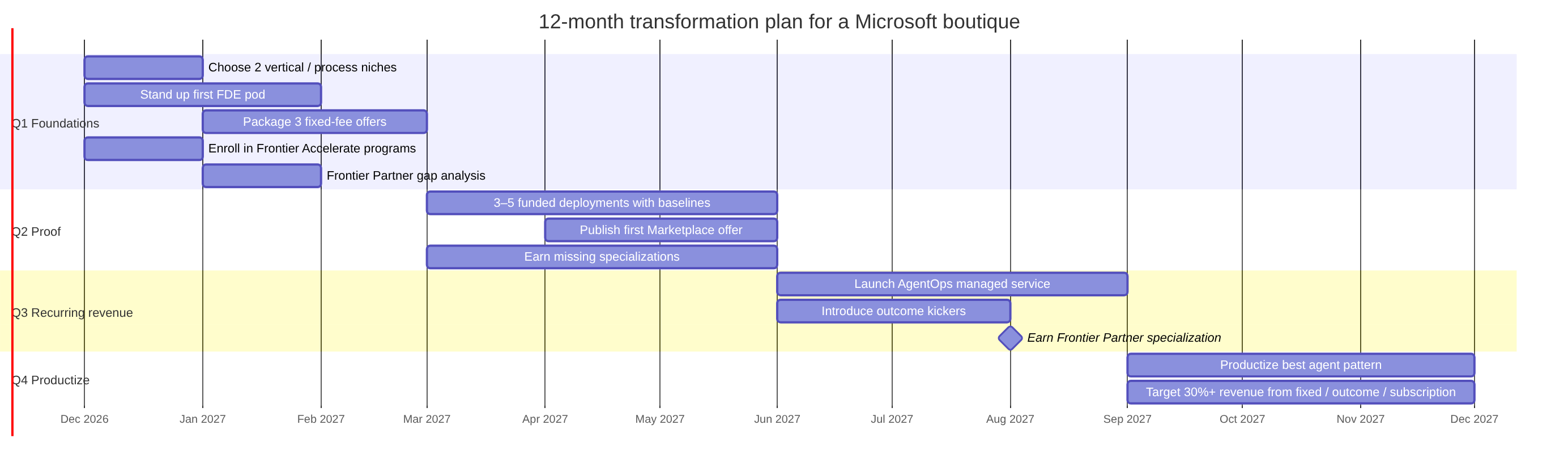
7. Risks, hype and what to verify
Risk map
| Risk | Evidence | Mitigation |
|---|---|---|
| Microsoft going direct | Frontier Company; GSIs named as FDE partners | Target mid-market and niches; co-sell into Frontier accounts; own the run phase |
| Commoditization of agent building | Low-code agents, vibe coding, 6,000+ pre-built agents from IBM and Microsoft | Compete on integration, governance, domain knowledge and measured outcomes |
| AI reducing billable hours | Outcome pricing at McKinsey; Deloitte's 2035 projection | Price on deliverables and outcomes, not hours |
| Shrinking resale margins | Run-rate rebate retired; 5% legacy SKU cut; channel moves earn growth only | Treat incentives as margin enhancers; drive usage growth |
| Agent project failure | Gartner: 40%+ canceled by 2027 | Governance-first scoping, baselines, explicit kill criteria |
| Talent competition | FDE medians ~$174K–$220K; labs and hyperscalers hiring | Profit-share, interesting work, internal re-skilling |
| Lock-in perception | Analysts warn Microsoft's roadmap becomes the client's architecture | Offer independent architecture advice and multi-model designs |
The skeptical view
Not everyone is convinced. Forbes contributor Peter Bendor-Samuel argued in April 2026 that FDEs are essential only in specific situations. FDE work is expensive, hard to scale, and carries lower margins than pure software. FDE without reusable IP is just expensive staff augmentation.
What to double-check before you commit
- Microsoft programs change constantly. Several FY27 details (Frontier Accelerate rates, the Agentic Partner Capability Score, ECIF terms) came from partner summaries rather than full Microsoft documents. Confirm in Partner Center.
- Numbers conflict. FDE growth rates, McKinsey's outcome-fee share and AI coding tool market shares all vary by source and definition.
- Vendor-sponsored claims include the Omdia estimate of up to $6.26 in services revenue per $1 of Marketplace software, the "up to 180% more" incentive projection, and partners' self-reported agent counts. Treat them as marketing until validated.
- Forecasts are not outcomes. Gartner's cancellation rate, Deloitte's 2035 projection and Indian IT layoff warnings are predictions.
- Frontier Company is new. How it prices work and shares it with partners outside the GSIs is still unclear.
The bottom line
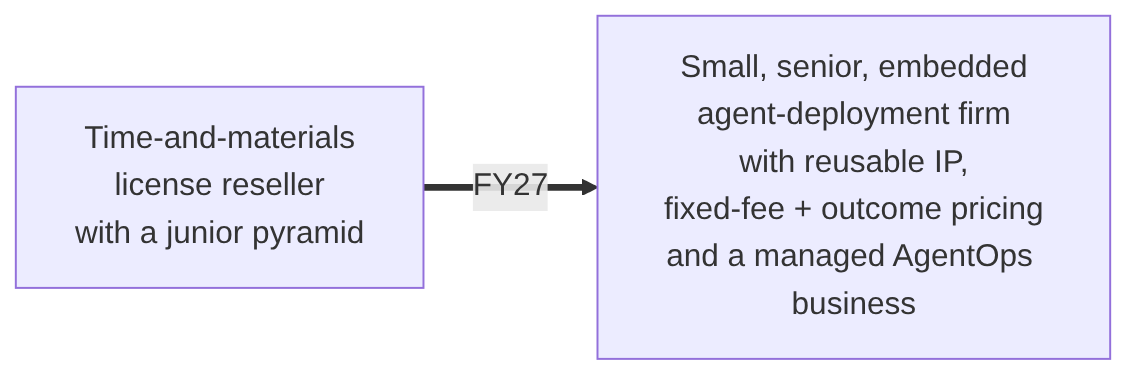
The Forward Deployed Engineer is less a job title than a delivery model: embed, ship, own the outcome, and turn every engagement into reusable IP. Microsoft has adopted it for its largest customers and changed partner economics to match, rewarding usage and growth over resale. Partners that copy the model at their own scale, in the segments Microsoft cannot reach directly, are well placed for the next cycle. Partners that keep selling hours and seats will find both getting cheaper.
Sources
Forward Deployed Engineering
- Palantir Delta vs Echo (Meet Hayat)
- A comprehensive analysis of Palantir's FDE model (Medium)
- Lightcast: Forward deployed engineer as an AI job
- Scaler: FDE jobs grew 1,165%
- Paraform: What is a forward deployed engineer
- Salesforce: Forward deployed engineer
- CNBC: AWS, Anthropic racing to deploy specialized AI engineers
- Avanade Forward Deployed Engineer job posting
- Gartner: Over 40% of agentic AI projects will be canceled by end of 2027
Software development trends
- JetBrains: AI coding agent adoption 2026
- METR 2026 developer productivity study (Ingenire)
- What METR, GitHub and DORA studies show (ValueAdd VC)
- InfoQ: Agent Framework harness GA
- Microsoft: Agent 365 now generally available
Consulting transformation
- Accenture Q4 FY26 earnings call transcript (Motley Fool)
- The Decoder: Deloitte tells consultants AI is coming for the billable hour
- AI Weekly: McKinsey ties 25% of fees to outcomes
- HFS Research: Horizons, agentic technology 2026
- HFS Research: Services-as-Software
- Business Quarter: Big Four cut graduate roles
- TCS layoffs 2026 (CareerCracker)
Microsoft partner ecosystem
- CNBC: Microsoft commits $2.5B, 6,000 employees to AI implementation unit
- Directions on Microsoft: Microsoft launches the Frontier Company
- Microsoft: Accelerating Frontier Transformation with partners (Nicole Dezen)
- Microsoft: MCAPS Start for partners 2026
- Microsoft: What's new for partners Q2 FY2027
- Partner Center announcements, September 2026
- Partner Center announcements, July 2026
- Microsoft Tech Community: Anatomy of a revenue-generating Copilot offer
- Sherweb: Microsoft updates for MSPs, July 2026
- TD Synnex: Microsoft FY27 partner strategy
- SoftSpend: How Microsoft rebuilt its commercial model for FY27
- Tieto earns the Microsoft Frontier Partner badge
- Quisitive achieves Microsoft Frontier Partner status (PR Newswire)
- Slalom earns Microsoft Frontier Partner badge
About the author
A highly skilled Cloud Solutions Architect with 20+ years of experience in software application development across diverse industries. Offering expertise in Cloud Computing and Artificial Intelligence. Passionate about designing and implementing innovative cloud-based solutions, migrating applications to the cloud, and integrating third-party platforms. Dedicated to collaborating with other developers and contributing to open-source projects to enhance software application functionality and performance
Comments
Join the discussionNo comments yet. Be the first to comment.